Ministry of Untruth: the Origins of Louisiana’s Ten Commandments Law
“Why would Arkansas pass an obviously unconstitutional law? Most likely because the state is part of a coordinated strategy among several states to inject Christian religious doctrine into public-school classrooms.”

*Originally published in Antigravity Magazine's November 2026 issue. (Also, special limited time offer at the end of the story!)
In the minds of Christian nationalists, America is God’s anointed land, a place right outside of Heaven’s pristine pearly gates, where our prosperity is the consequence of God’s light. In their minds, public life should be inundated with reminders that our founding fathers created our country in His image. Louisiana has now forced one of those reminders into every public K-12 classroom and higher learning institution in the state through the Ten Commandments law, deemed necessary to teach kids morals and Christian virtues. Naturally, a hate group has helped in spreading this message.
The Louisiana Family Forum, founded in 1998 by Gene Mills and Pastor Tony Perkins and designated as a hate group by the Southern Poverty Law Center, has been assisting with the legally mandated inundation of Ten Commandments displays. Mills told me that 60 of the 64 parishes “have been delivered adequate numbers of posters to fill each K-12 classroom.”
The rollout has faced legal hurdles over the past two years, with two lawsuits filed in the wake of its signing—one of them by Chris Dier, a history teacher at Benjamin Franklin High School in New Orleans and the Louisiana 2020 Teacher of the Year. Earlier this year, Dier’s lawsuit was dismissed, with a federal judge stating his lawsuit had been “premature.” But in August 2026, Dier petitioned the U.S. Supreme Court to block the law, garnering support—and some haters.
Dier told me the day after he filed the petition, “I was just looking at somebody on Facebook who wrote a comment under an article, and he said something like, ‘Why does this guy have so much hate?’ [in reference] to me.” Disturbingly, the commenter had an AR-15 in his profile photo.
In speaking with teachers across various parishes, there was an overwhelming feeling of frustration and surprise with the requirement to hang up the Ten Commandments posters. One teacher in Ascension Parish stated, “We didn’t understand how it was possible we were being told to hang up anything religious!” Another told me that state troopers delivered donated displays to their school. Some schools are wary of adhering to this law. But one teacher told me that their school “couldn’t wait to violate the Constitution.”
When supporters are pressed on why the Ten Commandments are necessary to education, their answer is often underpinned with one perceived incontrovertible truth: America was founded as a Christian nation.
For Mills, the Ten Commandments “were foundational to Western civilization and history.” Governor Jeff Landry has stated that America’s laws were shaped by the Ten Commandments, and that Moses was the original “law giver.” Supporters also often quote the founding fathers as evidence. Subparagraph 4 of Paragraph A of HB71 (introduced by State Rep. Dodie Horton), the law requiring the Ten Commandments in classrooms, states: “History records that James Madison, the fourth President of the United States of America, stated that ‘(w)e have staked the whole future of our new nation . . . upon the capacity of each of ourselves to govern ourselves according to the moral principles of the Ten Commandments.’”
The problem with that quote? It never happened. It was popularized by a 1988 book titled The Myth of Separation: What Is the Correct Relationship Between Church and State?, written by David Barton, a self-taught pseudo-historian and religious activist who has spent decades promoting the idea that America was founded as a Christian nation. James Madison scholars have never verified it. Barton would later say in 1996 that the quote was likely “false,” and WallBuilders, the multimillion dollar organization Barton founded, even acknowledges that quote was never found in any of Madison’s writings, though they believe it is “reflective of Madison’s expressed beliefs.”
Those who use the quote appear unconcerned with its veracity. When it was pointed out to Louisiana lawmakers that the quote was false, Rep. Horton brushed it off, saying it was “insignificant in the big picture of things.”
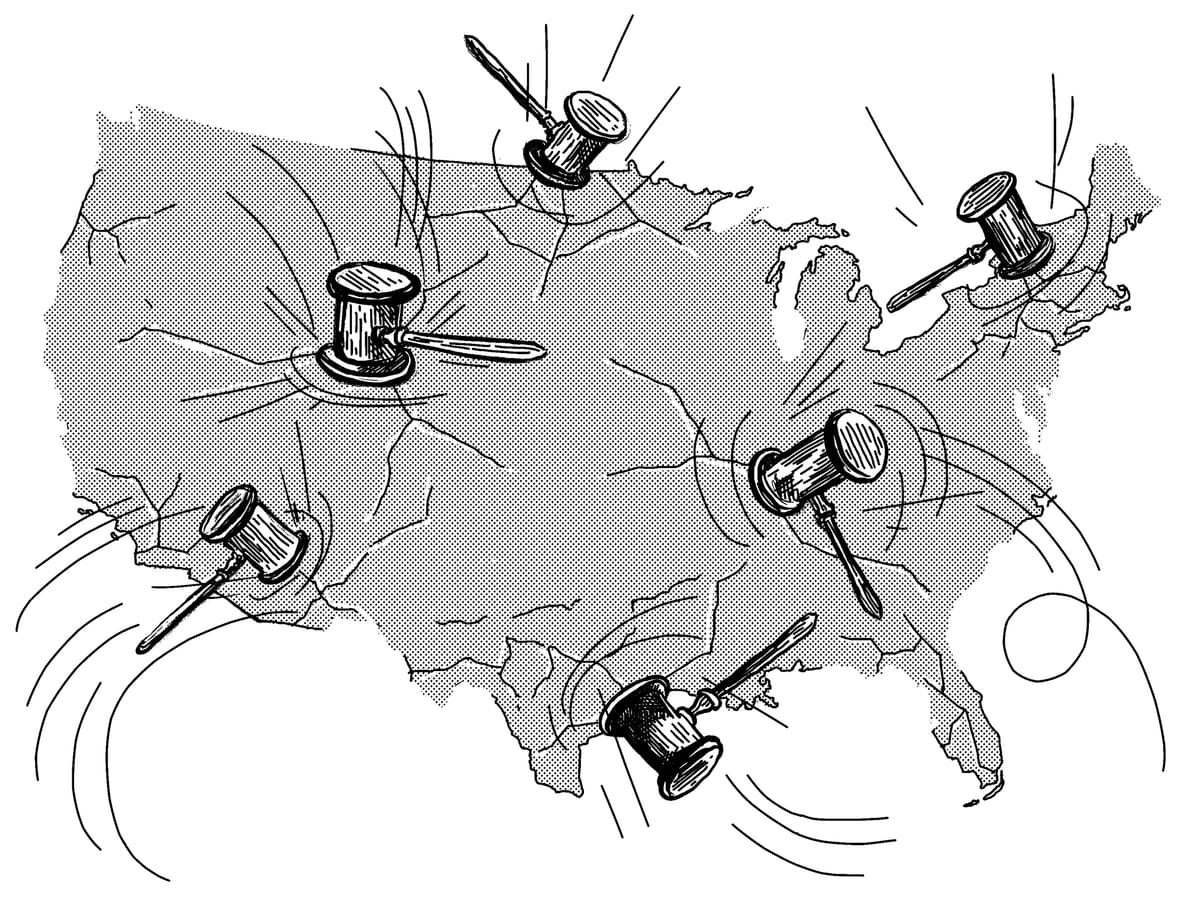
But despite the falsehoods fueling the Ten Commandments laws throughout the country, since 2021 there have been 82 Ten Commandments bills introduced across 26 states. Within the past two years, five states have passed such bills: Alabama, Tennessee, Louisiana, Texas, and Arkansas. If the history these laws are predicated on is false and similar laws have even been ruled unconstitutional, why do they keep popping up across the country?
The federal judge that blocked Arkansas’ Ten Commandments law in 2025 stated in his ruling: “Why would Arkansas pass an obviously unconstitutional law? Most likely because the state is part of a coordinated strategy among several states to inject Christian religious doctrine into public-school classrooms.”

Debunking Myths
When it comes to inserting religion into schools, conservative states are embroiled in what GOP state legislators view as a holy war. A Texas state lawmaker proclaimed during a legislative meeting on his state’s version of the Ten Commandments bill that the nation was in the midst of a “spiritual battle.” This battle is largely being played out within the education system, with conservatives’ main weapon being historical revisionism.
Though the Declaration of Independence does somewhat vaguely mention a “creator,” the U.S. Constitution does not mention Jesus or Christianity. Religion is only mentioned twice: once in the First Amendment, which bars laws “respecting an establishment of religion or prohibiting the free exercise thereof” in the Establishment Clause, and again in Article VI, which blocks “religious tests” for public office.
The founding fathers were not necessarily secular. Most came from a variety of religious backgrounds rooted in Christianity. Others practiced Deism or Theistic Rationalism. But their approaches to their various faiths differed on a spectrum of orthodoxy. Take President John Adams, who once told his wife in a letter that his Christianity “is not exactly conformable to that of the greatest part of the Christian World.”
But several founding fathers said in various ways that the country was not founded as a Christian nation and that a “wall of separation”—a term attributed to Thomas Jefferson—needed to be kept between the government and the church. One of the most explicit examples is in the 1797 Treaty of Tripoli, when the United States declared that the government was not “in any sense founded on the Christian religion” in Article 11 of the treaty. Pirates from North African Muslim nations began attacking American merchant ships crossing the Barbary corsairs. The treaty was meant to be an assurance to the Muslim state of Tripoli (now Libya) that America was not governed by Christian orthodoxy, and that there wouldn’t be any conflict or warfare on the basis of religious differences. “Christian nation” advocates will point to the fact that Article 11 was not in the Arabic version of the treaty, for reasons lost to time, but the English version that the Senate read and agreed with did have Article 11. The treaty was ratified unanimously by the Senate and signed by President John Adams.
Despite all evidence to the contrary, six in 10 Americans believe that America was founded as a Christian nation.
So why did this contemporary belief that America was founded as a Christian nation gain steam within the American right? You can thank the nefarious machinations of corporate America.
The Creation of a Christian Nation, and the Origins of Louisiana’s Ten Commandments Law
In the early 1940s, in the aftermath of the Great Depression, wealthy individuals and corporations faced backlash from the public for their role in the economic crash. President Franklin Roosevelt was also lambasting big business, once likening bankers and men of industry to criminal organizations, and boasting during his second term that they had “met their master.” FDR’s New Deal had expanded social aid programs but also reined in big business, bringing anti-trust lawsuits and expanding regulatory infrastructure.
Incensed by these new controls, industry organizations like the National Association of Manufacturers and the ultra-wealthy portrayed FDR as a “socialist” tyrant who exacerbated the hate they received from the public. These groups spent vast amounts of money on public relations campaigns to win back citizens, without much success. The Depression years had permanently eroded public trust. But finally, they saw an avenue: Sway the general public through faith leaders.
Business leaders from General Motors, General Electric, Standard Oil, Mutual Life, Sears, Roebuck, and more joined forces with a Los Angeles pastor named Reverend James W. Fifield Jr., who was called the “Apostle to Millionaires” due to the wealthy congregants who visited his church. According to the New York Times, the rich flocked to Fifield’s church because he believed that, in his words, “The blessings of capitalism come from God.” He emphasized rugged individualism and believed that FDR’s welfare state violated most of the Ten Commandments. He felt the New Deal encouraged Americans to covet their neighbors’ possessions, steal from the wealthy, and made a “false idol” of the federal government. Fifield became the face of the movement, leading a group called Spiritual Mobilization in the 1940s. From there, a years-long propaganda campaign was waged to infiltrate public consciousness through faith leaders, which a 1948 article in the Nation likened to “A major battle for the minds of the clergy.” The article speculated that there was big money behind the movement.
The movement, referred to by Princeton professor Kevin M. Kruse as “Christian Libertarianism,” aimed to get members of the clergy to adopt and promote their anti-big government, pro-free enterprise views by portraying the threat of big government as a threat to the nation’s historical Christian values. By February 1947, the Spiritual Mobilization’s clergy membership grew from 400 to 10,000. In their newsletter, they advertised pro-capitalism and libertarian books—like Friedrich A. Hayek‘s The Road to Serfdom—to clergymen, who then preached pro-capitalism sermons to their congregation. This led to a huge nationalistic Christian religious revival throughout the 1950s, and everyone, including large advertising firms, Hollywood, and celebrities, connected American prosperity to the nation’s Christian tradition.
This new religious revival intensified during the Cold War, as religion was waved as a national banner in the rallying cry against the Russians. The country’s relationship to religion shaped the decade and led to the election of Dwight Eisenhower, who made faith a centerpiece of his campaign and time in office. Eisenhower made popular anti-New Deal, anti-union televangelist Billy Graham his spiritual advisor. And Graham, who was being given a big nationwide push by businessmen (just like Fifield), pivoted his sermons away from the homegrown threat of “socialism,” “communism,” or labor unions, to warning his plethora of listeners about the threat of the Russians. The National Prayer Breakfast was created in 1953. “Under God” was added to the pledge of allegiance in 1954. And in 1955, a law was signed by Eisenhower that added “In God we trust” to all paper and coin currency. In 1956, the film The Ten Commandments—directed by Cecil B. DeMille, who was a congregant of Rev. Fifield’s church—came out as thinly veiled anti-communist propaganda. It grossed over $65 million domestically upon its release (or nearly $800 million in today’s dollars). Church attendance in America rose by 20% from 1940 to 1960, and millions of Americans were now trying to bring their religious worldview with them into the education system.
But the Supreme Court stepped in and made several rulings throughout the late 1950s to 1980s that hindered the way some white Evangelicals felt they should be able to run public schools and universities, and educate their children. This included the Brown v. Board of Education ruling in 1954, which desegregated public schools; rulings that blocked school prayer and mandated Bible reading in the 1960s; and rulings in the 1980s that sustained a 1970 IRS decision to strip Bob Jones University (a fundamentalist Christian university) of their tax exempt status for refusal to desegregate, as well as one that blocked a Kentucky law mandating the Ten Commandments in a school district.
In the 1970s and ‘80s, socially conservative evangelicals came to dominate the Christian right, and morphed into the religious right due to backlash from these rulings—especially desegregation and constitutional abortion. The religious right harbored the libertarian ideals of the Christian libertarians, but moved historical revisionism to the forefront as the lynchpin of their movement to remake America in every way possible, focusing especially on the education system. Christian nationalist thinkers, in opposition to secular education, started to write revisionist history books, built their own private schools and universities, and created homeschooling curriculum where their ideas were disseminated. These books introduced new generations to the idea of America as a Christian nation, tying symbols like the Ten Commandments to the founding ideals of the nation. The narratives they told weaved Christianity into the fabric of American identity, with the effect that a whole new generation of believers in the Christian-founding myth was created. One of the most popular writers of this genre was David Barton, the source of the Louisiana Ten Commandments bill.
David Barton built a multimillion-dollar empire off of spreading the myth that America was founded as a Christian nation. His books have been criticized for their historical inaccuracies, like referring to Thomas Jefferson as a “conventional Christian,” when he was in fact a theist who rejected Jesus’ divinity and the Trinity. But for 40 years, Barton’s ideas have dominated a large segment of American discourse. He has shaped history education in Texas, acting as an education advisor in the state government, and has had a role in various capacities in national Republican politics, influencing modern Christian nationalists like U.S. House Speaker Mike Johnson.
As learned through a 2018 investigation by Religion Dispatches, Barton and WallBuilders were the central figures of a then-secret initiative known as Project Blitz: a cross-country alliance that had the aim of injecting Christianity into every inch of American life, bombarding targeted states’ legislative chambers with so many copycat bills that opposition would get worn out trying to stop the onslaught. They wanted to start small, with easy-to-pass bills, then work their way up to those that are harder to pass. One of those “easy-to-pass” bills was putting the Ten Commandments in public schools.
After Barton and WallBuilders were exposed by Religion Dispatches, they changed names, resurfacing from the background years later. According to the news outlet The 74, in 2025 there were 28 Ten Commandments bills introduced in 18 states, all with language pulled from Project Blitz’s model legislation. In dozens of instances, the bills shared the same exact language, often using David Barton’s exact wording. When The 74 did their analysis, they noted that the Louisiana bill had the same language as the copycat bills that originated from Project Blitz.
Reporting from NOLA.com further highlights the origins of the bill, where Rep. Horton stated that an email from a lobbying group directly linked to WallBuilders inspired her to introduce the law. In fact, Barton’s son, the president of WallBuilders, spoke in support of the bill in a 2024 committee hearing.
What Happens Next?
Mills expressed that opponents—even those who share his faith—may join “the chorus of other protestors,” but he and Louisiana Family Forum will remain focused on “decision makers,” adding that “[u]ltimately the U.S. Supreme Court will serve as the final arbiter in this dispute.”
In 2022’s Kennedy v. Bremerton, the Supreme Court—using misrepresented facts—ruled in favor of a football coach who was fired for continuously pressuring his players to pray with him after games. Louisiana State Attorney General Liz Murrill has stated that the Kennedy ruling made it constitutionally permissible to implement the Ten Commandment law in public schools. If Chris Dier’s petition is accepted by the U.S. Supreme Court, we may find out that she’s right.
It’s of note that a petition to the U.S. Supreme Court doesn’t guarantee a case will get a ruling. The Supreme Court receives about 10,000 petitions a year and currently only issues signed decisions on about 60. But Dier isn’t the only one who has asked the Supreme Court to make a decision. Several families in Texas earlier in August 2026 also petitioned the Supreme Court, since Texas passed its own version of a Ten Commandments mandate.
If the Supreme Court doesn’t weigh in on the constitutionality of these laws, the rulings of the lower courts will stand as the binding law for their respective geographic regions, leaving the country legally fragmented. For example, since the Fifth Circuit Court upheld the law, and the Fifth Circuit covers Mississippi, Texas, and Louisiana, the Ten Commandments laws will be allowed to stand in those states. Arkansas, on the other hand, which had its Ten Commandments law blocked by a different federal court, would be constitutionally prohibited from mandating such laws. Different judicial geographical regions could have competing precedents, leading to confusion.
If the Supreme Court does weigh in and finds the mandate constitutional, their ruling will be a green light for other conservative states to pass similar measures.
For Chris Dier, this petition is not an anti-Christianity crusade but is about trying to uphold religious freedom, noting that his issue isn’t with Christianity, but instead, Christian nationalism. Dier is concerned about potentially getting national attention if the Supreme Court accepts his petition. But he is unwavering in his convictions: “Any time you put yourself out there to fight for what is right and fight against injustice, you inevitably kind of [make] yourself a target… But I know that what I’m doing is the right thing to do, and I would feel bad if I stood idly by while this was happening. What better cause than to fight for your students and students around the country?”

LIMITED TIME OFFER:
 Danny Cherry Jr.
Support my work by:
- Sharing this story on social media
- Subscribing (and becoming a paid subscriber to help grow the newsletter!)
- Or if you are feeling up to it, buying me a coffee :)
Oh, I also wrote a crime novel set in 1920 New Orleans.
YOU MAY ALSO LIKE:
 Danny Cherry Jr.