For the first time since Reconstruction, Mississippi has a Black U.S. Senator
"Every single county in a state that clings so longingly to its history of white supremacy that it celebrates the 33-year tradition of Confederate Heritage Month shifted an average of 23 points to the left."
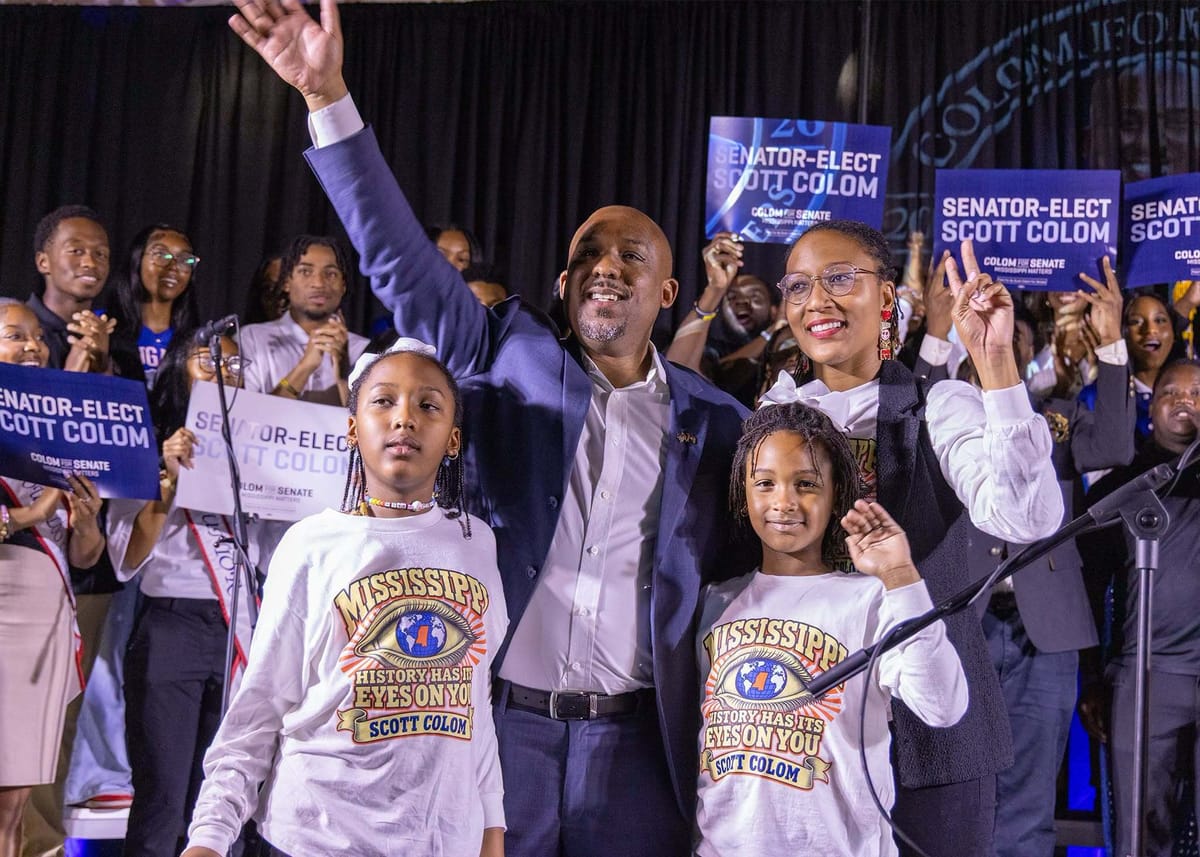
Since the early 1880s, we’ve seen once deadly diseases get cured, two world wars, nations collapse, planes take to the sky, a man walk on the moon, and the rise of AI, but prior to yesterday, we hadn’t seen a Black U.S. senator from Mississippi.
Until yesterday, the last Black folks to represent Mississippi in the U.S. Senate were Republicans Hiram Revels, who served from 1870 to 1871, and Blanche Bruce, who served from 1875 to 1881. They were both selected by the state legislature and the first two Black senators in the country following the Civil War.
However, segregationist Democrats would forcefully take over Mississippi right before the federal government abandoned the Reconstruction efforts, and they would dominate the state for close to a century before ceding power to conservative Republicans, who essentially turned Mississippi into a one-party state for decades.
But on the afternoon of November 11th, CNN was the first to spread the news that Democrat Scott Colom—a Black man and former local prosecutor—was heading to DC to represent the Magnolia State. He beat his Republican opponent, Cindy Hyde-Smith, 49.2% to 48.7%.
He will be the first Democrat to represent the state since John Stennis—a segregationist—won the seat in 1982.
Major election forecasters, like Cook Political Report, doubted him, with most of the projections showing that Mississippi was "solidly Republican” for the vast majority of the race.
Colom took notice of the doubters. He stated in a tweet a few days ago: “[Cook Political Report] made it much more difficult to fundraise and are part of the reason the South has been neglected for so long.”
According to CNN, Georgia Sen. Raphael Warnock said to a room full of donors in April of this year, “There’s one race I think we’re sleeping on, and that’s Mississippi.”
They all laughed.
But the national Democratic Party belatedly put over $15 million towards the campaign once they saw the tides turning, and eventually, Colom would gain endorsements from former President Barack Obama and Bill Clinton and former Vice President Kamala Harris.
Black voter turnout was a major key to his victory.
The Supreme Court’s Louisiana v. Callais ruling, which weakened the Voting Rights Act, caused anger among Black voters, which led to a surge of high turnout among the Black electorate all across the South. Strength In Numbers estimates that Black voters turned out at a clip of 96% of presidential-year levels in the Deep South, compared to about 71% for white and other voters.
In Mississippi specifically, Black folks made up 33% of the electorate in the 2026 midterm election, a 3-point increase from 2024. But stating that high Black turnout was solely a manifestation of anger would diminish the fact that in Mississippi, activists like Stacey Abrams have quietly built organizing infrastructure to mobilize Black voters, and that work paid off.
Colom was also able to get a sizeable margin of white voters to flip to his side in a state where voting is highly racially polarized. In 2024, Trump carried the white vote in the state by a margin of 83-16; this year, Hyde-Smith was only able to garner a margin of 73-25.
But Colom wasn't just racking up victories in counties that were deep-red—these were counties with histories steeped in racism. Colom flipped Forrest County, which is named for the first grand wizard of the KKK during the Reconstruction era, Nathan Bedford Forrest.
He flipped Yazoo County, where a racist registrar shot a pistol at the feet of a Civil Rights Division lawyer who had come to inspect his records.
Every single county in a state that clings so longingly to its history of white supremacy that it celebrates the 33-year tradition of Confederate Heritage Month shifted an average of 23 points to the left.
Colom's ground game throughout the campaign focused on talking directly to voters, shirking the old conventions of relying solely on ads or rallies. He and his volunteers talked to people at hair salons and Waffle Houses and barbershops; they chatted up workers at fast food restaurants and big box stores.
He campaigned in all 82 of Mississippi's counties, including in Neshoba County, where in the 1960s, three civil rights movement activists were arrested by cops, handed over to the KKK, then murdered, with their bodies later discovered in an earthen dam on a farm, all for having the audacity to register Black Mississippians to vote. This same county shifted 23 points to the left.
Hyde-Smith, who didn't do much campaigning, provided ample ammo for Colom to use against her throughout their contest. In a February interview, she responded to a question about rising beef prices by saying her constituents "have so many proteins to choose from.” Colom turned that clip into a viral commercial, with the commercial’s actors stating, “Pick another protein? I’d rather pick another senator instead.”
What makes Colom’s victory ironic is that Hyde-Smith blocked him from a seat on the federal judiciary about three years ago over his support of trans athletes. But Colom has stated before that his decision to run had nothing to do with revenge.
In a comment earlier this week, he also showed he wasn’t focused solely on being the first Black person to head to DC to represent Mississippi in the Senate. He just didn’t want to be the last: "For me, it's my job to make sure I make it easier for the next Black boy or girl that has the work ethic, the vision, and the values to do public service if they want to be a United States senator."
Throughout the campaign Colom showed he had the work ethic to win, despite being underfunded for much of it. But in his victory speech at Tougaloo College, among hundreds of cheering supporters and thunderous applause, he didn’t take all of the credit. Colom stated, "They did not believe a moment like this was possible, but I kept the faith… It's not something that I did, y'all. It's something we did."
Support my work by:
- Sharing this story on social media
- Subscribing (and becoming a paid subscriber to help grow the newsletter!)
- Or if you are feeling up to it, buying me a coffee :)
Oh, I also wrote a crime novel set in 1920 New Orleans.
YOU MAY ALSO LIKE:
 Danny Cherry Jr.
 Danny Cherry Jr.