My Interview With a Former Christian Nationalist and GOP operative
"There's approximately over 1 million homeschooled kids in the US right now that are being most likely trained like I was."

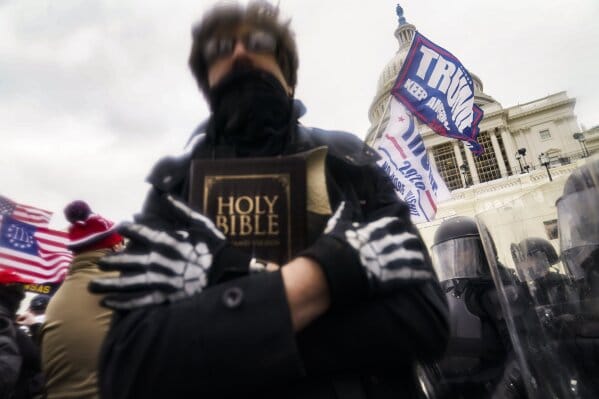
“We will use guerrilla tactics to undermine the legitimacy of the dominant regime. We will… spread the idea that there is something fundamentally wrong with the existing state of affairs… [we must] contribute to a vague sense of uneasiness and dissatisfaction with existing society… We need to break down before we can build up. We must first clear away the flotsam of a decayed culture.” - Eric Heubeck, “The Integration of Theory and Practice: A Program for the New Traditionalist Movement.”
In “The Integration of Theory and Practice: A Program for the New Traditionalist Movement,” published in 2001, Eric Heubeck wrote his vision for a Christian nationalist revolution. Though, he doesn’t describe it in those terms—he uses the phrase “New Traditionalist.” In fact, he’d likely consider himself a “Christian Conservative”—a term Christian nationalists use because, quite frankly, it sounds less frightening. But I opened this piece with a quote from his manifesto because I wanted you to get a glimpse into the way the Christian nationalists think. They view politics as an arena for combat, in which anything goes, even if it means they have to upend society to win. The examples of tactics he gives in the manifesto speak to a movement that wanted to stay under the radar until it was time to strike. And in the 2016 and 2024 election, we saw decades of that secretive planning come to fruition, in the election and re-election of President Donald Trump.
The secretive nature of the movement is aided by a web of think-tanks and ultra-religious legal organizations that wheel and deal behind the scenes in order to put the pulpit in public life and indoctrinate our kids to be warriors for their version of Christ.
The most prominent organizations within the movement are Heritage Foundation, Family Research Council, and Leadership Institute. Heritage is the organizer of Project 2025 but has been tearing down our society since the Reagan Administration. In fact, the aforementioned Heubeck’s mentor was Paul Weyrich, the co-founder of Heritage Foundation. Family Research Council is an anti-queer group, and one of the main sources of anti-trans legislation. Leadership Institute is the boot camp that all aspiring Christo-fascists go to in order to learn how to upend democracy. Their founder is Morton Blackwell, a former Reagan staffer, and Heritage Foundation co-founder as well. Leadership Institute has claimed to train over 250,000 right-wing activists, school board members, pundits, lawmakers and more. In that number is Mike Pence, Mitch McConnel, and many more well-known right-wing figures. Also included in that number is anti-trans influencer and sore loser, Riley Gaines, a former college swimmer. Leadership Institute also trains other rightwing groups. If you're one of my fellow Louisianans, you know a group they've worked with: Citizens for a New Louisiana. (I’ve written about them.)
Though the movement is more known now and we know the names of the groups involved, we still rarely ever get the insight into what the inside of the movement is like. We only see their impact, in the form of incidents like anti-abortion and anti-trans bills; and the January 6th insurrection.
But, sometimes adherents to the movement leave the movement. Sometimes even, they talk to the press, like Michelle Boxx.
Boxx, according to her Instagram bio, is a writer, business scaler, podcaster, traveler, and political fixer. She’s also a former teenage GOP operative and Christian nationalist, who has had ties (to varying degrees) with the groups I mentioned above.
What follows is a condensed version of a conversation between me (in bold italics font) and Michelle Boxx.
I'm so happy to get to talk to you. I'd love to know about your volunteer background and how you got into politics.
I was raised very Christian nationalist, so I was trained to, or taught, or indoctrinated, however you want to put it, to understand politics from a really young age. 12 years old was my first time I ever volunteered in a US Senate campaign… I was trained in a lot of things like Teen Pact [Leadership School] ... the first time I did a Leadership Institute training was probably 16. And then I did another one at 18… I was speaking at events. I was working on political campaigns around the country.
There's a group I'm investigating [called Citizens for a New Louisiana] ... and I know that they trained with the Leadership Institute, but I'm not sure what this training actually entails.
The Leadership Institute has multiple different trainings. I went through the same one twice, and that one is really all about managing political campaigns or stopping them in some respects... but also in terms of media training... like how do you make contact with reporters. Or, how can you get yourself published in the press? How can you write press releases? The other part of it too is they would run through a lot of scenarios. So let's just say hypothetically, you're managing a political campaign. How can you get [negative] information about the other side for a negative perspective, without it being traced back to your candidates? How can [you] strategize in a way to make sure that you're getting candidates elected.
Oh I got you. The group I’m investigating has had some success taking over library boards and I noticed that the leader of the group is waging psychological warfare on people. So is that something that comes up in Leadership Institutes training?
Yes and no, so they're never [going to] call it that, right? It's [going to] be a little bit more subtle, but… yeah, there's psychological warfare perspectives that you could definitely take from it. I think the main thing would be just like… How do you do messaging in the media that strategically paints the other side in a negative light? What terms can you use, what things can you say, how to think all that through, how to strategize all that through. So yes, psychological warfare, but of course it will not be termed as that.
I'll just give you one example [of what CFNL] has done: they had one woman tailed by a private investigator... I just didn't know if that was something [Michael Lunsford, CFNL leader] was taught to do, or if that's a little bit more aggressive...
Yeah… that sounds very likely… these kinds of organizations, these kinds of people... it gets very intense very quickly if you're not on the side they want you to be on, and especially if you walk away from it as well. So,... that makes total sense to me... I know of a lot of similar stories and things like that have happened to me too.
I've always been very curious when researching this type of stuff. How much of this actually has to do with religion versus power... I never can tell how much they actually believe the Bible aspect of what they're saying versus what's just convenient messaging to cover up the fact that they just want power.
I think it depends what level of person that you're dealing with. So I would say the top [of the movement] probably don't care that much about religion. Some of them still do, but for a lot of them, it is more about power. Now, some of them could still have that concept of faith still woven into it, because Christian nationalists do believe, of course, that we have to be a Christian nation, which means converting everybody over into Christianity and living that way. So I will say there's a large percentage that absolutely believe that they're doing this as a Christian crusade and it's based on their beliefs. So it all just depends on the level.
I got you. So there's a reality in which like the top leaders of the movement, I guess you can say, don't buy into it as much whereas the grassroots does.
Yeah, that would be a great way to look at it, yeah. And the grassroots are willing to do a lot of work for basically free because it's for, you know, Jesus or the advancement of that cause.
I don't know how familiar you are with Paul Weyrich—one of the founders of the Heritage Foundation—but I found this quote where he said that he wanted to make abortion a thing that makes people get out of bed in the morning... it doesn’t seem like Republicans have voters, it seems like they have foot soldiers.
That's 100% how they do it... especially if we get kids in [the movement] really young too, right? There's approximately over 1 million homeschooled kids in the US right now that are being most likely trained like I was. I was an ambassador for [Teen Pact] and we would be actively recruiting kids. Basically parents would pay to send their kids there, and then they move on to places like Leadership Institute or work in Washington D.C. in the future and that kind of thing.
So it kind of does seem like to some extent it's all about indoctrinating the next generation is a big part of the movement.
100%. A lot of people that are working in DC right now on the extreme nationalist conservative side probably started out similar to where I started out.
I've read some Christian Nationalist manifestos and there's this obsession with public schools.
Yeah, it's a huge part of the conversation. Public schools are essentially the devil. I mean that's why they want to shut down the Department of Education... [plus] the separation of church and state and that kind of thing, they completely disagree with. So if they can't get enough religious teachings inside public schools, they’d rather everyone be homeschooled.
What do you think makes Christian nationalists support somebody like Trump who obviously doesn't abide by the Bible?
Great question. I've never supported Trump, but when I've asked people who are more Christian nationalist leaning, It's interesting. Some do believe that he's a man of faith, which is insane to me. And then the other side don't believe that, but they, they at the same time feel like, OK, this is finally a guy who's going to implement what we want because they were all really mad at Bush, for example, for not firmly implementing the way that they wanted him to implement. And a lot of other presidents, they don't feel like have gone far enough and they felt like Trump would go so hard in implementing these Christian nationalist values and we're so closely tied with the Heritage Foundation that they were like, yeah, absolutely, let's go. We don't care.
Uh, so it's kind of like they just saw somebody who was willing to do anything for them, so they just kind of ignore all the other bad parts of him.
Exactly. We'll explain it away.
Didn't you list the Heritage Foundation as one of the organizations you've worked with before?
Yeah, so I am familiar with them a little bit. I've been inside their offices. I wouldn't say worked with them in-depth... [I was involved with] something called Teen Pact Leadership School [which] trains people at state capitals, training students for a week at state capitals. Teen Pact Congress was the attempt to get Christian nationalist students in on the more federal level. And the Heritage Foundation, we toured their offices, sat with them quite a bit, talked to them about policy, that kind of thing. So, I was part of that initial flagship team and now I think they still have Teen Pact Congress running last I checked. So that happens every single year and they'll take kids around K Street [in Washington DC]. And teach them about what the Heritage Foundation does, why it's so great... It all starts with the kids.
So when I've talked to people they refer to it as white Christian nationalism and not just Christian nationalism. Would you say that white supremacy is a big part of the movement?
I would say no, but I’m not [going to] say it's not in certain segments. It wasn't in the segment that I was around. Yes, there's more in terms of involvement [in the movement] on the white side, and they definitely thought less of any other cultures... So I will say they're not going to call themselves white supremacists. They're not going to even call themselves Christian nationalists. I just started using that term when I realized that everyone else was calling them that to help explain and get my point across. So, no, it doesn't come across that way... It's just much more subtle than that in terms of the separation and the segregation and everything. So yes and no... but I was [also] going to [add] the thing that's most interesting too is just how Christian nationalists will move on over time if, if too much backlash happens; we'll just shut that [operation] down and be nice and quiet.
So like enough backlash happens, the movement will move off of a subject or an issue.
Right. So if it hurts enough with recruiting or conversion or anything along those lines, they will move off of it. So, I mean, I, I think it'd be hard for us to find very many people at this point on that side that would openly admit that they aren't for interracial dating, and a lot of them will even tell you that they might be OK with, you know, homosexuality as well. But again, obviously we're seeing with Trump, everything is taking a huge step backwards because how people feel more emboldened to say all those really out there viewpoints.
Almost like the movement can be mask-off now that Trump's back in the [White House]... my viewpoint is, I think the end goal is to have the country kind of resemble the TV show or the book Handmaid's Tales. I don't know if you ever saw it or if you're familiar with it.
First of all, I haven't watched Handmaid's Tale or read the book. I know I need to. A lot of people are comparing a lot of my TikTok videos and what I'm saying [to Handmaid’s Tales]. This is probably going to sound extreme too, but I just know from my being raised in [the movement]. You look at a lot of Sharia law and the Taliban... The leadership and a lot of people who are more intense with it, they want to see us go that far, but on the Christian conservative scale... I think everybody should be really, really concerned. And I think that even if things go underground again for a little while, the worst part about this whole Christian nationalist movement is the fact that they literally believe they're going to hell if they don't push this, and they believe everybody else is too. So you have to realize that that's such an extremist view. It is such an existential view that even if everybody goes underground, they're still gonna be training kids up. They're still going to be doing exactly what they did with kids like me, and they're still going to be waiting for their moment again. And so I think that there's more conversations that need to be had because this isn't something that's just going to fade away.
I realized months ago this isn't as simple as just winning an election every 4 years... There's this quote I found in this manifesto, where the author said something like "evangelicals have to build their own parallel society under the mainstream one." And whenever I read that, I thought that was scary. Like, to think about the fact that there's an extremist movement happening under mainstream society. How do you uproot that from a society without a Civil War? Is there any way possible to uproot Christian nationalism from our society? How do people fight it, I guess I'll ask?
Yeah, honestly, I don't have an answer fully yet... It is so nefarious, in the sense of indoctrination. You shouldn't, right? But like if you're not going to indoctrinate everyone on the other side to combat it, and again, you shouldn't, then what do you do exactly? Because then you're gonna have a lot of people with a lot of different views and a lot of different perspectives and they're not going to be as unified. And again, you have to remember with Christian nationalists, this is an existential threat for them, and they believe hell is a tangible place... right now my job and the way I look at it is [my job is] just informing people as much as possible of what's happening and honestly really focusing on prioritizing democracy. Then frankly a lot of legislation needs to come down and come into place around child labor and campaigns and then also in terms of homeschooling and other things like that... the main thing that they try to do is they try to isolate their children. And so if you can do your best to help the next generation be involved with people who think differently than them and make it a requirement, you have a shot. So it's a multiple generational thing here. This isn't just going to happen. And I think that that's the main issue is that a lot of times, I think on the other side, it's harder to stick with these broader agendas [for opposing Christian nationalism] for a longer period of time because again it's not an existential threat [for opponents to Christian nationalism]. Until it is now. And you have to remember too that a lot of Christians on the more ground level see themselves as incredibly loving, because they are literally trying to save people from hell. So, I mean, they think they're doing this like really great noble and well-intentioned thing.
Yeah, that reminds me of something that used to come up when I was in a Christian school. Uh, they used to tell us to be warriors for Christ. Is that something that y'all were ever told?
Oh yeah, I was literally taught that not only is hell a tangible place, but you should be willing to die for your faith. It was really intense stuff. So basically like, hey, you know, if, if anyone ever comes up to you and you know, put a gun to your head—this is under the age of 10—or like a knife to your throat and says like, do you believe in Jesus, you had better say yes and be OK with that.
How did you get out of it? Like what made you leave the movement?
So, part of it was Trump running for the presidency. Uh, that was part of it. There's a couple of layers of things for me that happened over a period of time. I got married really young, as you're supposed to do in that whole section. I was raised that a woman wasn't supposed to have a career... I always rebelled against that. But women are allowed to have a career in politics. So that was accepted. And so I really went towards that direction. I ended up getting married at 18, and it was not a good situation for me. Basically I had to make a decision for myself... And so once I got out of that, I left Christianity for good. Then in terms of the politics side, at about [age] 24 or 25,... Trump was running and I was like, “absolutely not. I'm not supporting this guy.” This is not even at all what I felt like I was raised around and I was really confused... then the next thing that happened is a friend of mine needed an abortion. And I got the call when I was about to walk into the Republican headquarters for a local election I was managing. And from there, I told her “I completely support you. I totally get it.” And I just knew in that moment that I was no longer Conservative or Christian on all those fronts.
What would y'all have called yourselves, if not Christian Nationalists?
I just called myself Christian and conservative. I would say fiscally, socially conservative, and I would have called myself a Christian. That was basically it. It sounds nice and not majorly threatening, right? That's why Project 2025 was so huge because they published that out there and really wrote it down, which enough people didn't understand or believe that that was going to be implemented or understood what was really in it.
So would you say that if we were to have a chance at defeating Christian nationalism in the long term, we need to have strong, education regulation or education reform, like protecting public schools, stuff like that… essentially protecting what kids learn.
100%—I think that really making it clear that things like Teen Pact or, you know, the Heritage Foundation or whoever else can't be 501c3s [as well]. They can't be nonprofits. They have to be taxed and make it harder for them to operate and function. And also Teen Pact exists, by the way, out of a lot of child labor. A lot of their staffers are minors. So that's something to look into, but there's a lot of organizations like that with the Leadership Institute and so forth, right? They let a lot of these kids get into these programs. So it's not just education reform and restricting homeschooling, it's understanding like, hey, also the parents can't be sending their kids to these indoctrination camps. And I mean, I don't really know how you regulate that over time, but the real thing is if the kids are forced to be exposed to people who don't think like them, it's pretty unlikely that they're going to become conservative later. Because imagine having to believe that all the, you know, crazy levels of Bible stories are real. Having to believe that, you know, people that you care about who don't look like you are problems, right? They're not going to adopt that later in life if they're exposed to enough people who are different from them.
Support my work by sharing my newsletter with a friend, subscribing, or if you are feeling up to it, buying me a coffee :)
Please report typos if you see them! Just be nice about it!
Oh, you can also become a paid subscriber, too. All money will be used to grow the newsletter!
I also wrote a crime novel. K that’s it.
(Personal news: I was chosen for Gambit’s NOLA 40 under 40 :) )
LATEST STORY:
 Danny Cherry Jr.